
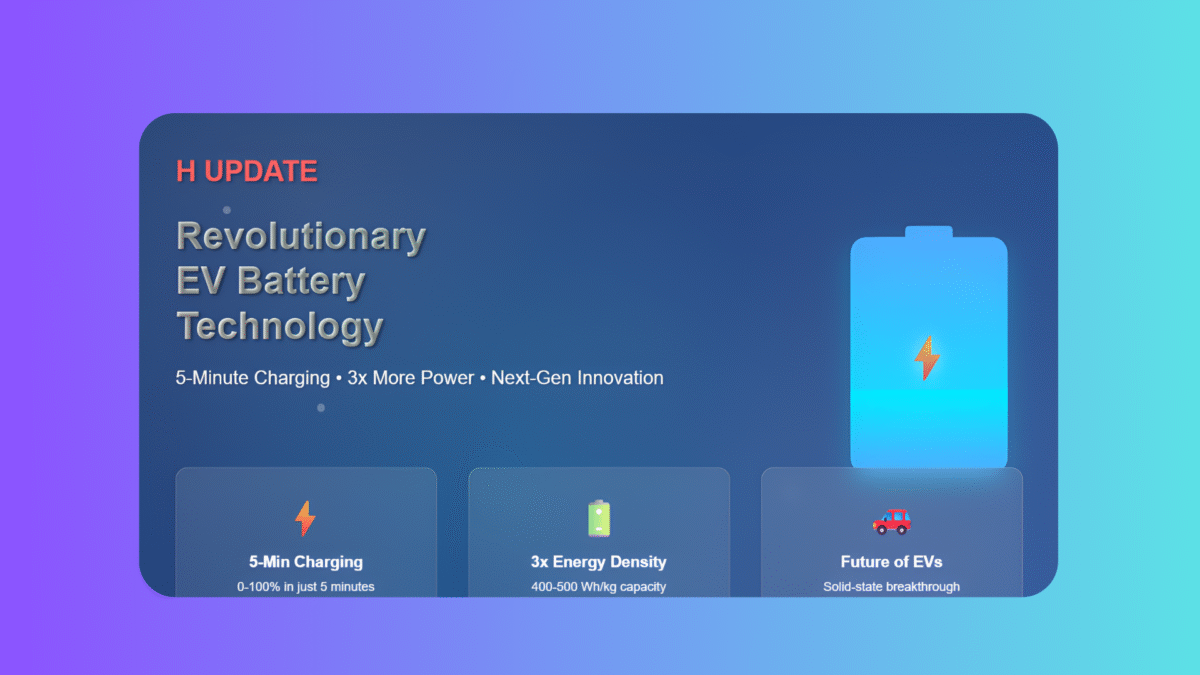
The Chinese tech giant Huawei has claimed to develop a new solid-state EV battery with a driving range of 3000+ km on a single charge. Furthermore, it can be fully charged in merely 5 mins.
Huawei’s New Electric Car Battery Could Change Everything
Huawei has filed a patent for a new type of battery that could make electric cars much better. This battery uses a special material called nitrogen-doped sulfide electrolyte.
Why Is This Battery Special?
More Power: This new battery can hold 400-500 Wh/kg of energy. That’s 2-3 times more power than the batteries we use today in electric cars.
Super Fast Charging: The best part? You can charge your electric car from 0% to 100% in just 5 minutes. Right now, it takes hours to fully charge most electric cars.
What Makes It Work?
The secret is in the special material they use. Current batteries have problems with something called the “lithium interface” – basically, the battery parts don’t work well together and can cause dangerous reactions.
The new battery fixes this by adding nitrogen to sulfide electrolytes. This is Huawei’s breakthrough solution that stops the bad reactions and makes the battery safer.
But There’s a Catch
Expert Opinion: While this sounds amazing on paper, experts say it might not work in real life. The results come from lab tests, not from actual cars driving around.
Cost Problems: The biggest issue is money. These sulfide electrolytes are very expensive – about $1,400 per kWh (around 1.20 lakh rupees). This makes the batteries too costly for regular people to buy.
Production Challenges: Making millions of these batteries for all the cars people want to buy is very hard and expensive.
Conclusion
This new battery technology from Huawei sounds incredible and could revolutionize electric vehicles. However, there’s still a long way to go before you can buy a car with this battery. The main problems are the high cost and the difficulty of making these batteries in large numbers.
For now, this remains an exciting possibility for the future of electric cars, but not something you’ll see in showrooms anytime soon.
Furthermore, the inadequate infrastructure to support the ultra-fast charging rates is another major challenge among others. Huawei is presently not in the business of manufacturing power batteries, but the heavy investments made by the company in recent times in battery research and materials suggest that it intends to become a mainstream player in future.
One more point to notice here is that the driving range of 3000+ km on a single charge provided by Huawei is based on the CLTC (China Light-Duty Vehicle Test Cycle).
On the contrary, if we consider the EPA cycle, it will come down to 2000+ km, which is still by far more than any of the mainstream EVs on sale right now in any part of the world.
Several leading global battery manufacturers such as Toyota, Samsung SDI, and CATL aim to begin commercializing solid-state batteries by 2027–2030.
However, Huawei with its recent claim has took everyone by surprise and if materialised, it could change the face of the EV industry. It could entirely eliminate range anxiety and charging delays, therefore promising a brighter and bolder future of EVs.