
Huawei News
Huawei releases the Intelligent World 2030 Report

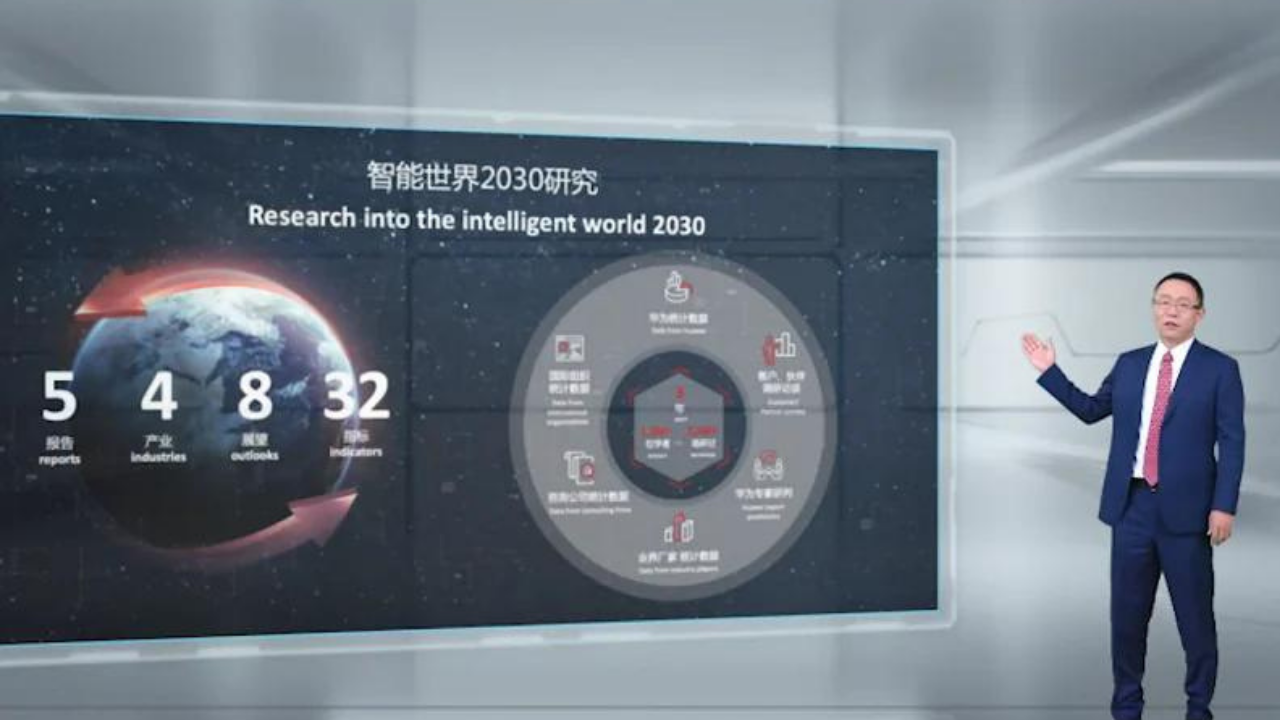
Huawei recently held the Intelligent World 2030 Forum and released the “Intelligent World 2030” report at the conference. It is predicted that by 2030, the total number of global connections will exceed 200 billion. At the same time, enterprise network access, Home broadband access and personal wireless access break through 10 Gigabit, ushering in an era of 10 Gigabit connections.
Imagination will determine how far we will go in the future, action will determine how quickly we will reach the future, and the best way to predict the future is to create it. There are still plenty of challenges to overcome on the road to the intelligent world. As David Wang said at the end of his speech, “We believe, the greatest wisdom is found in shared ideas. Dreams are the key driver of social progress. Moving towards the next decade, let’s work together to shape a better, intelligent world.”
Outlooks for the intelligent world 2030: We will live a better life in 2030, with more food, larger living spaces, renewable energy, digital services, and no traffic. We will be able to relinquish repetitive and dangerous work to machines, and have secure access to digital services. To meet these needs, we have set eight directions for exploration, including health, food, living, and transportation.
In 2030, we will be able to identify potential health problems by computing and modeling public health and medical data, shifting the focus from treatment to prevention. Precise medical solutions powered by IoT and AI will become a reality.
In 2030, vertical farms unaffected by climate will be applied on a large scale, so that we can provide green food for all. 3D printing will make it possible for us to create artificial meat to meet our nutritional needs.
Our homes and offices will become zero-carbon buildings. Next-generation IoT technology will build adaptive home environments that understand our needs.
New energy vehicles will become the mobile “third space”. New aircraft will make emergency services more efficient, reduce the cost of medical supplies, and change the way we commute.
In addition to healthcare, food, living spaces, and transportation, Huawei has also explored the future of cities, energy, enterprises, and digital trust. We look forward to working with you to explore endless possibilities in 2030.
Communications Network 2030:By 2030, as technologies such as XR, naked-eye 3D display, digital touch, and digital smell develop further, “digital vision, digital touch, and digital smell” will create an immersive and disruptive experience through next-generation networks. At the same time, as networks evolve from connecting billions of people to hundreds of billions of things, network design will change from focusing on human cognition to machine cognition.
As part of the intelligent world, the communications network of 2030 will evolve towards cubic broadband networks, deterministic experience, AI-native, HCS, security and trustworthiness, and green and low-carbon networks. Huawei predicts that the total number of global connections will reach 200 billion by 2030. At the same time, enterprise network access, home broadband access, and individual wireless access will exceed 10 Gbit/s, ushering in an era of 10 Gbit/s connectivity.
Computing 2030: By 2030, the digital and physical worlds will be seamlessly converged, allowing people and machines to interact perceptually and emotionally. AI will become ubiquitous and help us transcend human limitations. It will serve as microscopes and telescopes of scientists, enhancing our understanding of everything from the tiniest quarks to the largest cosmological phenomena. Industries already making extensive use of digital technology will become more intelligent with AI. Computing energy efficiency will increase dramatically, bringing us closer to zero-carbon computing. Digital technologies can become a tool for achieving the global goal of carbon neutrality.
Digital Power 2030: In the next decade, humanity will enter the digital power era, striving towards low-carbon development, electrification, and intelligent transformation. New renewable energy sources, such as photovoltaic and wind power, will gradually replace fossil fuels. Power electronic technology and digital technology are being deeply converged to enable “bit to manage watt” throughout the energy system and realize various intelligent applications on the “energy cloud”. Huawei predicts that by 2030, solar energy will become one of our main power sources, the proportion of renewables in global electricity generation will be 50%, the share of electricity in final energy consumption is expected to exceed 30%, electric vehicles as a proportion of new vehicles sold will exceed 50%, and renewable energy will power 80% of digital infrastructure.
Intelligent Automotive Solution 2030: The automotive industry will witness the development of intelligent driving, intelligent spaces, intelligent services, and intelligent operations. Huawei hopes to use its ICT technologies to enable an intelligent automotive industry and help carmakers build better vehicles.
Huawei predicts that, by 2030, autonomous vehicles will account for 20% of new vehicles sold in China, electric vehicles will account for more than 50% of new vehicles sold, vehicles will come equipped with computing power of over 5,000 TOPS, and in-vehicle network transmission speed per link will exceed 100 Gbps.
(Via)



Huawei is getting ready to release a new super-thin phone called the Mate 70 Air. Some details about this phone have already been leaked online, and now a new picture has appeared showing what it looks like.
What the phone looks like
A promotional poster for the Huawei Mate 70 Air was leaked today. The phone looks similar to other phones in Huawei’s Mate 70 family, but it’s much thinner.
The back of the phone has a round camera area with Huawei’s XMAGE camera logo on it. The edges of the phone appear to be shiny and polished. The back cover has a textured surface, similar to another Huawei model called the Mate 70 Pro+.
What’s inside the phone
There isn’t much information available yet, but the Mate 70 Air might be a mid-priced phone. Early reports said it would have 12GB of memory and either 256GB or 512GB of storage space. However, newer information suggests it will actually have 16GB of memory.
The phone is expected to have a large 6.9-inch screen. It will also have a high-quality main camera.
Other features
Unlike Apple’s iPhone Air, the Huawei Mate 70 Air will have a slot for a physical SIM card. The phone will run on Huawei’s HarmonyOS 5.1 software. It will come in three colors: black, white, and gold.
Huawei is expected to launch this phone in November, around the same time as its Mate 80 series.

Tipster Digital Chat Station has confirmed that the Chinese tech giant Huawei will release new phones called the Mate 80 series in November. These new phones will have better designs, cameras, and speed.
The company is expected to compete with Apple’s new iPhone 17 phones. Huawei will make four different Mate 80 phones: the regular Mate 80, Mate 80 Pro, Mate 80 Pro+, and Mate 80 RS. Each phone will have different cameras. The regular Mate 80 will have a 50-megapixel camera.
The Pro version will have a bigger 50-megapixel camera. The Pro+ and RS models will have even bigger 50-megapixel cameras.
The Pro model might have a flat screen and face recognition. The Pro+ and RS models might have curved screens that bend more.
The best phone, the Mate 80 RS, might have a 6.9-inch screen with special technology.
This screen should be brighter, use less battery power, and last longer than normal phone screens. Huawei might also use strong titanium metal for the frame and special glass on the back. Inside the phones, there will be a new chip called the Kirin 9030. The battery might be bigger than 6000mAh and charge very fast – 100W with a wire and 80W without wires. The phones might work with 5G internet and satellite communication.
The phones will use Huawei’s own software called HarmonyOS. This might work better with other Huawei devices and have more AI features. Some people think these improvements will help Huawei compete better with Apple, especially in battery life, communication, and smart features.

A Chinese company called HiSilicon Semiconductor just changed who’s in charge. The old boss, Xu Zhijun, stepped down from his job as the legal representative and chairman. Now the company’s CEO, Gao Ji, is taking over these roles.
Xu has been working at Huawei since 1993 and still has other important jobs there – he’s a vice chairman and sometimes serves as the rotating chairman. Him leaving this position is probably just Huawei moving people around to different jobs within the company.
HiSilicon is completely owned by Huawei and makes computer chips. This change in leadership might mean Huawei is trying to make things work better.
HiSilicon started in October 2004 when Huawei took its computer chip design team and turned it into its own company. The main office is in Shenzhen, but they also have offices in Beijing, Shanghai, and other cities in China.