



According to Huawei’s rotating chairman, the sales revenue is expected to exceed 700 billion yuan in 2023. Hu Houkun said that (2023) the ICT infrastructure business remains stable, the terminal business is better than expected, the digital energy and cloud business achieves good growth, and the competitiveness of smart car solutions is significantly improved.
In December last year, Xu Zhijun, then the rotating chairman of Huawei, revealed that Huawei is expected to achieve sales revenue of 636.9 billion yuan in 2022.
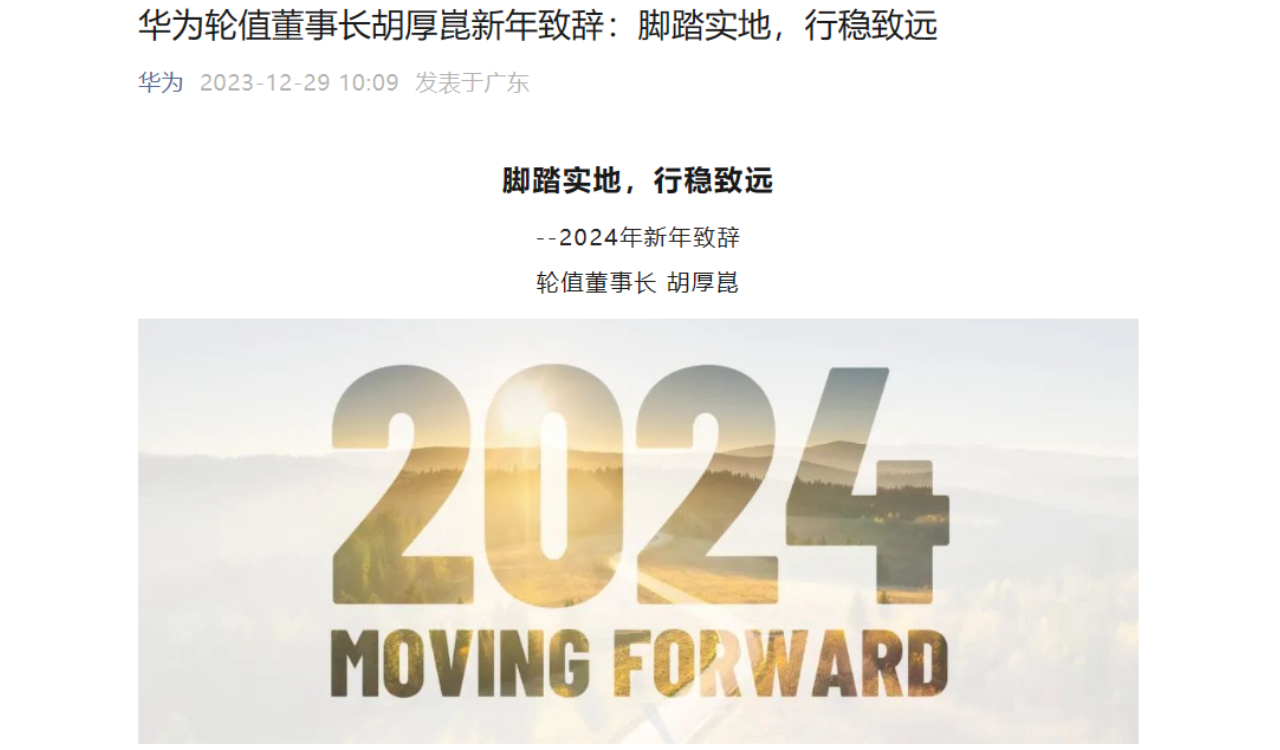
Here’s the Huawei’s rotating chairman Hu Houkun’s New Year’s speech:
After several years of hard work, we have withstood the severe test and the company’s operations have basically returned to normal. It is expected to achieve sales revenue of more than 700 billion yuan in 2023, of which the ICT infrastructure business remains stable, the terminal business is better than expected, the digital energy and cloud business achieves good growth, and the competitiveness of smart car solutions is significantly improved. Here, on behalf of the company, I would like to express my gratitude to our customers who have always trusted and supported us, to our industry chain partners who have been with us through thick and thin, to all our employees who have worked hard and unyieldingly, and to our family members who have made silent contributions. It is the common belief that allows us to break through the blockade and move forward side by side.
In the past year, front-line marketing and service employees worked hard to ensure the stability and security of customer networks. In July when the typhoon raged, communication infrastructure in many places in China was severely damaged. Together with operators, we went to the front line to seize the network; the European storage team reversed the unfavorable situation of the business environment and won customers with excellent solutions. “Very satisfied”; Indonesia’s Jakarta-Bandung high-speed railway, the local delivery team practiced “in Indonesia, for Indonesia” and quickly completed the construction of the communication network along the line in 120 days; in Burkina Faso, the project covered hundreds of kilometers of rivers and lakes, and was delivered Veterans visited every operation site to complete all construction before the rainy season; Latin American customers proposed emergency expansion due to network congestion and required 26 days to complete delivery. The delivery team overcame difficulties and made the impossible possible… . Employees in various systems such as R&D and supply have worked hard and made progress in business continuity and technological advancement. Smart terminals have resumed large-scale supply. MetaERP has completed the switching of more than 200 subsidiaries around the world. Computing power has achieved scale breakthroughs and commercial use. Euler Basic software such as operating systems and Gaussian databases have been used in many industries, and Hongmeng ’s self- developed kernel has obtained the industry’s highest level of security certification.
Hard work has allowed us to survive and grow, but the challenges remain severe. The uncertainty of geopolitics and economic cycles, as well as the continued impact of technical sanctions and trade barriers, are profoundly reshaping the structure of the global industrial chain and business rules.
No matter how the external environment changes, we firmly believe that digitalization, intelligence, and low-carbonization are the most certain development trends. We must maintain strategic focus, give full play to our comprehensive advantages in industry portfolio, technological innovation, and complex software and hardware platforms, and work with ecological partners to continue to provide customers with high-quality products and services. We must actively embrace windows of opportunity and invest limited resources in the most critical strategic directions. At present, breakthroughs in large models have enabled artificial intelligence to move from workshop-style development and scene-based customization to industrial development and large-scale applications. Large models require large computing power. We must build the world’s leading computing power base to prosper thousands of industries.
In 2024, all business units must focus on value creation and produce more food. The ICT infrastructure business gives full play to its comprehensive advantages in computing, storage, network and other fields, fully supports the digital transformation and intelligent upgrade of various industries with its system engineering capabilities, and serves as the company’s ballast. Operator services must support customer network traffic filling, business innovation and network evolution, and help operators succeed in business. The terminal continues to be committed to creating king products and building a high-end brand with warmth. Work with partners to accelerate the transformation of mobile applications into Hongmeng, achieve a historic leap forward in the Hongmeng ecosystem, and provide consumers with the ultimate experience in all scenarios. Huawei Cloud must not only become the base and enabler of the company’s digitalization, but also become a trustworthy digital “black land” for all walks of life. Digital energy must continuously improve product quality and competitiveness, seize the deterministic opportunities of low-carbonization, contribute more profits, and achieve valuable growth. Smart Automotive Solutions works together with partners to transform technological advantages into business success. Each operating responsibility unit must inspire confidence but not be blindly optimistic. It must identify risks, especially manage inventory risks and improve operational efficiency.
Quality is our lifeline, and we must ensure the security and stability of the network and platform through end-to-end quality management. Networks are becoming more and more complex, digital and intelligent products are being used more widely and deeply, and quality has become a key consideration for customers when making choices. We must regard quality as the primary competitiveness and make solid products. The successful experience and capabilities accumulated in quality management over the past thirty years must be replicated and developed based on the characteristics of each industry, and extended outward to suppliers, channels and ecological partners, through end-to-end quality management systems and capabilities Build to provide customers with high-quality, competitive products and solutions.
Ecological construction is a key task for the growth of computing, government and enterprise, consumer, Huawei Cloud and other businesses. Huawei’s capabilities are limited, and it must focus on the products and services it is good at. The creation of powerful platform capabilities cannot be separated from the in-depth integration of technology and scenarios, as well as the in-depth participation of partners and the ecosystem. We must change our thinking, adhere to the concept of openness and altruism, gather industrial strength, and regard partnership and ecological construction as a long-term strategy. We must be brave enough to take on the hard nut, focus on the creation of ICT root technology, and the ability to build complex software and hardware platforms, and open these capabilities to partners in a platform-based and service-oriented manner, giving full play to partners’ advantages in scenario-based solutions, and realizing partners’ Mutual benefit and win-win cooperation with Huawei.
The overall strategic direction has been basically determined, and the company will continue to streamline its organs, simplify management, follow rules and regulations, and optimize appropriately. Operational power has been moved downwards, and budget management has been moved upwards. Each business unit must improve its operation and management capabilities and awareness as soon as possible and independently assume end-to-end operation and management responsibilities. We will continue to promote the review and conclusion of contracts in the representative office and realize the independent operation and independent decision-making of the representative office. The company will use assessment and incentive policies to guide different industries to collaborate and share benefits; through deployment policies, it will encourage mature industries to proactively transfer outstanding cadres and experts to new industries such as computing, cloud and digital energy, so as to quickly seize opportunities and achieve efficient growth. This is not only conducive to accelerating the organizational construction of new industries and promoting the metabolism of mature industries, but also provides new development opportunities for employees. An organization full of vitality and hope has huge combat power and unlimited potential.
As the company moves forward, cadres must also keep pace with the times. They must not only dare to fight, but also be good at fighting. Cadres must have a clear strategic direction and work ideas, prepare a battle map, and complete knowledge upgrades and capability transformations for new businesses and new technologies as soon as possible. They must take the initiative to assume greater responsibilities and make contributions in key battlefields and critical periods. The company’s cadre selection policy is also being optimized, emphasizing responsibility for results and contribution, adhering to the selection system, and implementing the cadre resume system. Generals are made by fighting. We must select cadres from the battlefield, only assess those cadres who have made contributions, and try to allow as many heroes who have made contributions to emerge and grow as possible. We must organize a team of cadres who can lead modern operations and lead the company to new successes.
Continue to carry out business environment, compliance, network security and privacy protection in a pragmatic manner, protect the bottom line of survival, and safeguard business development. We must realize that changes in the external business environment are not only caused by geopolitical conflicts, but also by changes in the global economic cycle. We must be able to view such changes maturely, understand the industrial policies and demands of different countries and regions, and actively contribute . Compliance is a rigid requirement for company development. The more changes and turmoil the environment becomes, the more we must do a good job in compliance management and risk control. Network security and privacy protection are the cornerstones of business development. Through the construction of an end-to-end governance system, we will continue to provide customers with safe, trustworthy, and resilient products and services. We have always adhered to “one country, one policy”, and we must also do a good job in the promotion, replication and differentiated adaptation of excellent experience, do a solid job, communicate pragmatically, and win the trust and support of customers and stakeholders.
People need precipitation and accumulation in order to become stronger. In the past, we did not give up due to tremendous pressure, nor did we become impetuous due to external praise. The road ahead is still difficult and dangerous, but history always favors those who have faith. We must continue to work hard, unite all forces that can be united, overcome difficulties, be down-to-earth, and move forward steadily to win greater victory. Great times are created by people, and we will definitely make heroes and shine brightly.
I wish you all a Happy New Year!